
I’ve been an HO-scale modeler for many years. I enjoy the scale because it has just about everything a modeler could ask for in terms of models, supplies, and tutorials. When I got back into the hobby in earnest back in 2012, I had caught the prototype modeling bug and was seriously afflicted. My interest in branch lines and short wheel based diesels led me to model an interesting section of the Iowa Interstate Railroad called the Milan Branch. This short section of track had all the things that I was looking for: a branch that operated exclusively in yard limits, had a small but diverse number of industries with a variety of car types, and was serviced by two of my all-time favorite locomotives—an SW1200 and GP10. For over ten years I labored, albeit at the pace of a turtle, to build this dream layout. But a strange thing started to happen several years ago that would change my modeling direction in a significant way. I got introduced to top-level military modeling.
Military modeling? Good heavens, man, we’re model railroaders! True, but I had become enamored by the skill and variety of themes that our friends in the military modeling camp enjoy. As I watched video after video of the military guys cranking out amazing dioramas, a seed was planted in my mind and it started to grow. I became disenchanted with a prototypical, single-themed layout that required me to stay focused on only one specific area within the railroading sphere. Diorama builders, on the other hand, can focus on a theme for a relatively short amount of time, complete the project, and get excited about moving onto a whole new interest. This approach is very similar to what fine artists do. Over time, I started to think about a different approach to my railroad modeling that would emulate how the military modelers approach different themes.
At the same time, I was also being influenced by minimalistic modelers. You know, the kind of modeler who lays down a couple of spurs, sparse scenery, and shuffles four to five cars around and is completely content and fulfilled? I began to see that is what I wanted, too. And, to go along with all this new contemplation, I was fostering a keen interest in a larger scale that would enhance the sound and mass of railroading.
Before I weary you with more (sic) gripping narrative, I better give you something to look at…
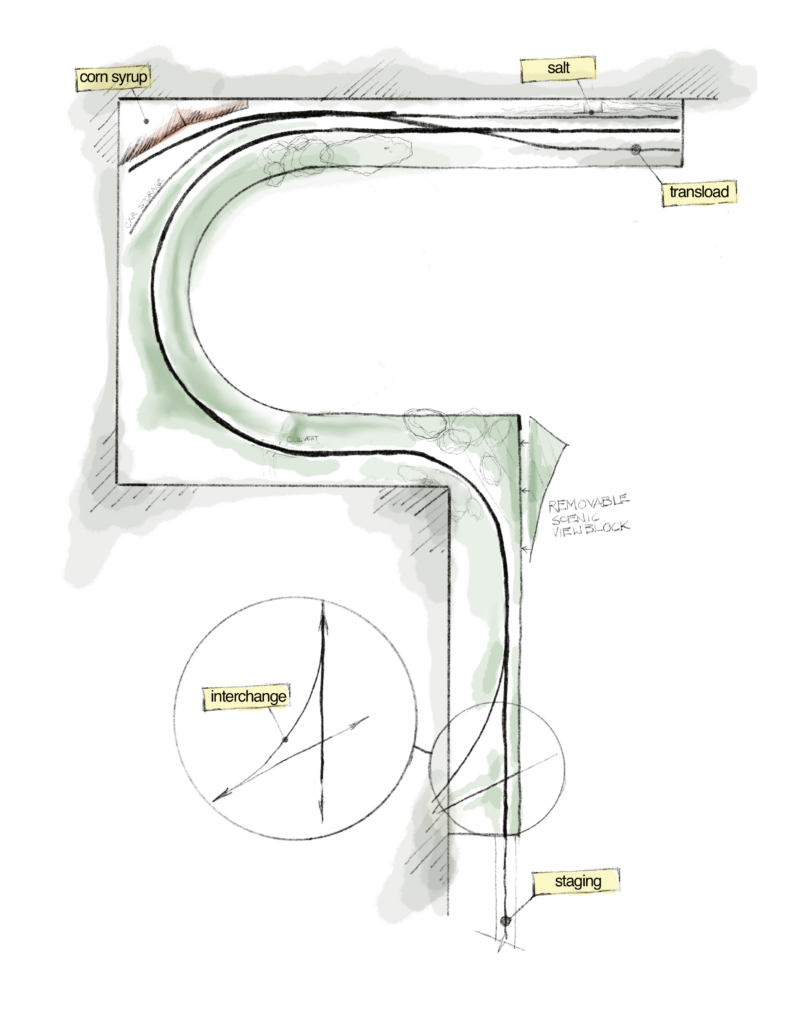
Introducing my new O-scale layout, the Paint Creek & Waterville line: a proto-freelance railroad set in the late 1990s. This wonderful hand illustration was rendered by my friend, Chris Mears. Chris is a creative soul who, like me, likes to delve deep into all aspects of creative layout design and discussion. I would be remiss if I didn’t recommend Chris’ blog, “Prince Street” (princestreet.wordpress.com). There you will find all kinds of interesting narratives and discussions about all things model railroading. Check it out.
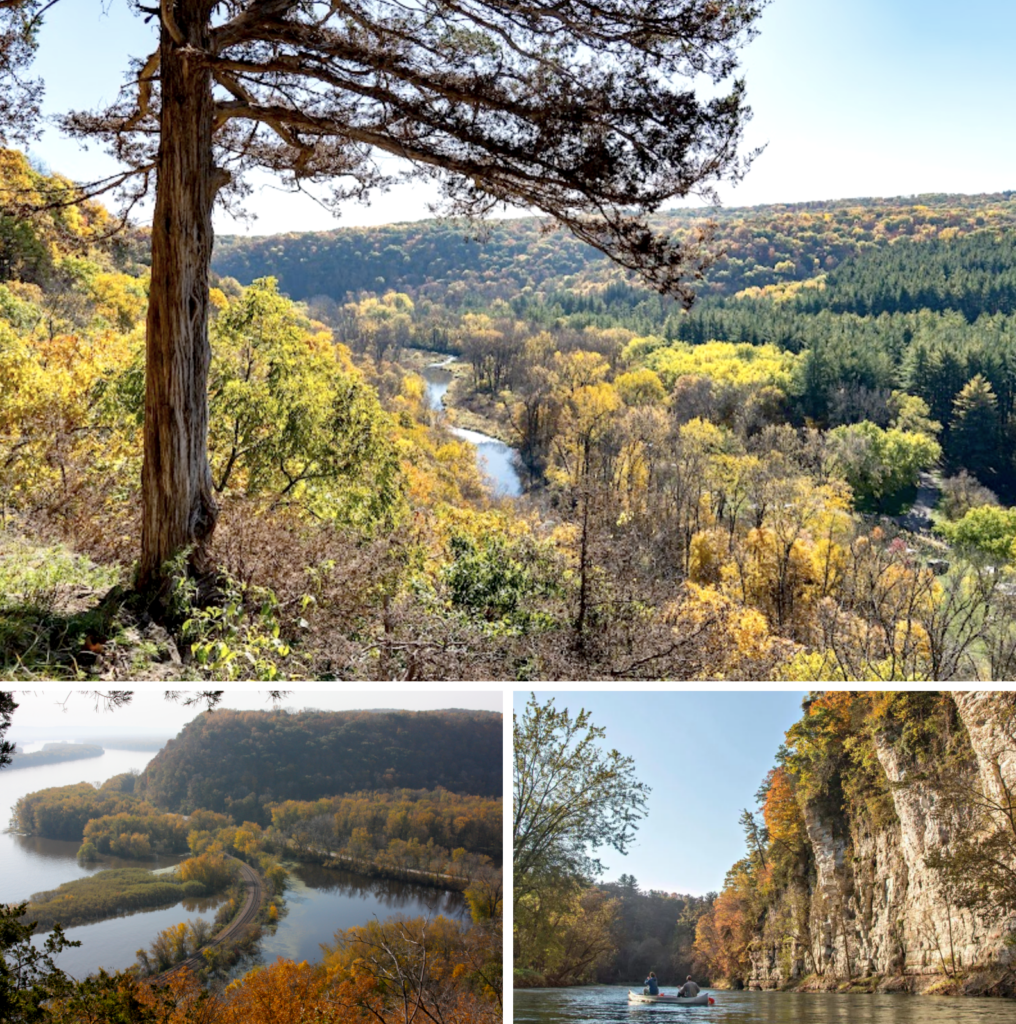
The PC&W was inspired by an old Milwaukee Road branch line called the Waukon Branch that ran in northeast Iowa until it was abandoned in the early 1970s. It was a scenic line that connected with the Iowa Division of the Milwaukee at Waukon Junction along the Mississippi River. From there, it progressed west up the limestone bluffed valley following the Paint Creek tributary, passed the charming town of Waterville roughly mid-distance along its length, before arriving at its terminus of Waukon, Iowa. The valley is very scenic with Paint Creek winding its way down through the narrow bluffs. There were many bridges that crossed the creek that had weight restrictions, and track curves were quite sharp in spots which required lightweight SW1s as the assigned power.
The PC&W follows the same benchwork footprint as the Milan branch, but obviously in a much more condensed form. I like the fact that the larger scale forces me to think creatively about how the track is configured and how the scenes will blend together. I want the railroad to be minimalistic in design and operation, but also give the impression that there’s more to the line. In addition, I plan to separate the layout into three distinct scenes via two scenic elements. More on that shortly.
On the south end of the plan there will be a short staging track where I‘ll need to fiddle cars in real time to get more on a particular train. This is a compromise, but the space available only allows two engines and three cars. As the train moves north, it will pass over an interchange crossing with the Iowa, Chicago & Eastern. The interchange will allow several cars to be spotted on the siding for both pick up and delivery.
Next, the track moves through a rather tight 44-inch radius curve. To help obscure the fact that the curve is tight, and to add a scenic element, I plan to model a cut through the curve with limestone bluffs. The cut will also help divide the interchange scene from the next scene which will feature a small bridge passing over Paint Creek (note: not represented on the track plan). Once a train is past the bridge, the track will pass under an ubiquitous county road wood overpass. The overpass will help divide the creek scene from the final location which is a simple country industrial area featuring a transload spur, salt dealer, and corn syrup terminal. Each one of these industries was carefully chosen to provide a good variety of operations using different car types: the transload area for any type of car that can be loaded/unloaded by forklift, truck, or end loader; a salt dealer to spot beat up, rusty hoppers who’ve seen better days; and a corn syrup terminal that receives tank cars of different grade syrup. There is no run around in the industrial section, and this was by design as I plan to use two engines working in tandem to move cars. For such a small, condensed area, using the two engines back-and-forth will provide much needed play value for the operators.
There’s much more to come, so please stay tuned and feel free to comment.

Chris is an amazing artist. I’m really looking forward to following your build Scott!
I love it already! Nice slow-paced track plan.
Slow is what I like, and what I’m becoming as my age keeps advancing!
Just listened to your conversation on Around the Layout which brought me here to check out your layout information. I model in O scale and hand lay my track and can’t wait to watch the progress on your layout.
Thanks, Roger!